Over the past two years, AI-powered tools have transformed how businesses build internal systems, automate workflows, and launch new ideas. Need a CRM? There’s an AI tool for that. Need an internal workflow app? You can generate one in a weekend. Need dashboards, reporting, automations? Done in days - sometimes hours.
It’s genuinely impressive.
But there’s an important distinction most businesses don’t think about:
Prototyping quickly is not the same as building something that lasts.
And that difference matters more than ever.
The Power of AI Tools (And Why We Use Them Too)
Let’s be clear - AI tools are incredible.
They are currently (at the time of this article) perfect for:
- Rapid prototyping
- Validating business ideas
- Testing workflow concepts
- Exploring process improvements
- Internal tools with limited scope
- Short-term operational needs
AI dramatically reduces the cost of experimentation. What used to take weeks of development can now be validated in days.
For early-stage ideas, this is a game-changer.
You can:
- Test before committing major capital
- Refine requirements in real-time
- See workflows in action
- Avoid building the wrong thing
And we encourage this approach in the right context.
But here’s where the conversation needs nuance.
The Hidden Layer: What Experienced Developers Do Behind the Scenes
When seasoned developers design a system, the visible interface is only a small part of the work.
What really determines long-term success happens underneath:
- Database architecture
- Data relationships
- Scalability planning
- Security modelling
- Permission structures
- Performance optimisation
- Future-proofing integrations
- Data migration strategies
- Technical debt management
These are invisible decisions. You don’t see them in the UI. But they are what determine whether a system thrives for 10 years - or collapses after two.
AI tools can generate functionality. They don’t replace architectural judgment.
The Longevity Question Most Businesses Don’t Ask
Here’s a hard truth: Many SaaS platforms don’t survive 10 years.
Business models change. Pricing structures shift. Tools get acquired. APIs get deprecated. Features disappear.
We’ve seen it repeatedly.
Meanwhile, some of the systems we’ve built for clients are still operating successfully after more than a decade.
They’ve evolved.
They’ve scaled.
They’ve integrated with new technologies.
They’ve supported business growth.
Why? Because they were built with intentional architectural decisions from day one.
Not just “Can we build this quickly?” But:
- How will this perform at 10x scale?
- What happens when the business model changes?
- What happens when we add new divisions?
- How portable is the data?
- Can this system survive market shifts?
That level of thinking is not automated. It comes from experience and context of the clients' cicrumstances.
Speed vs Strategy
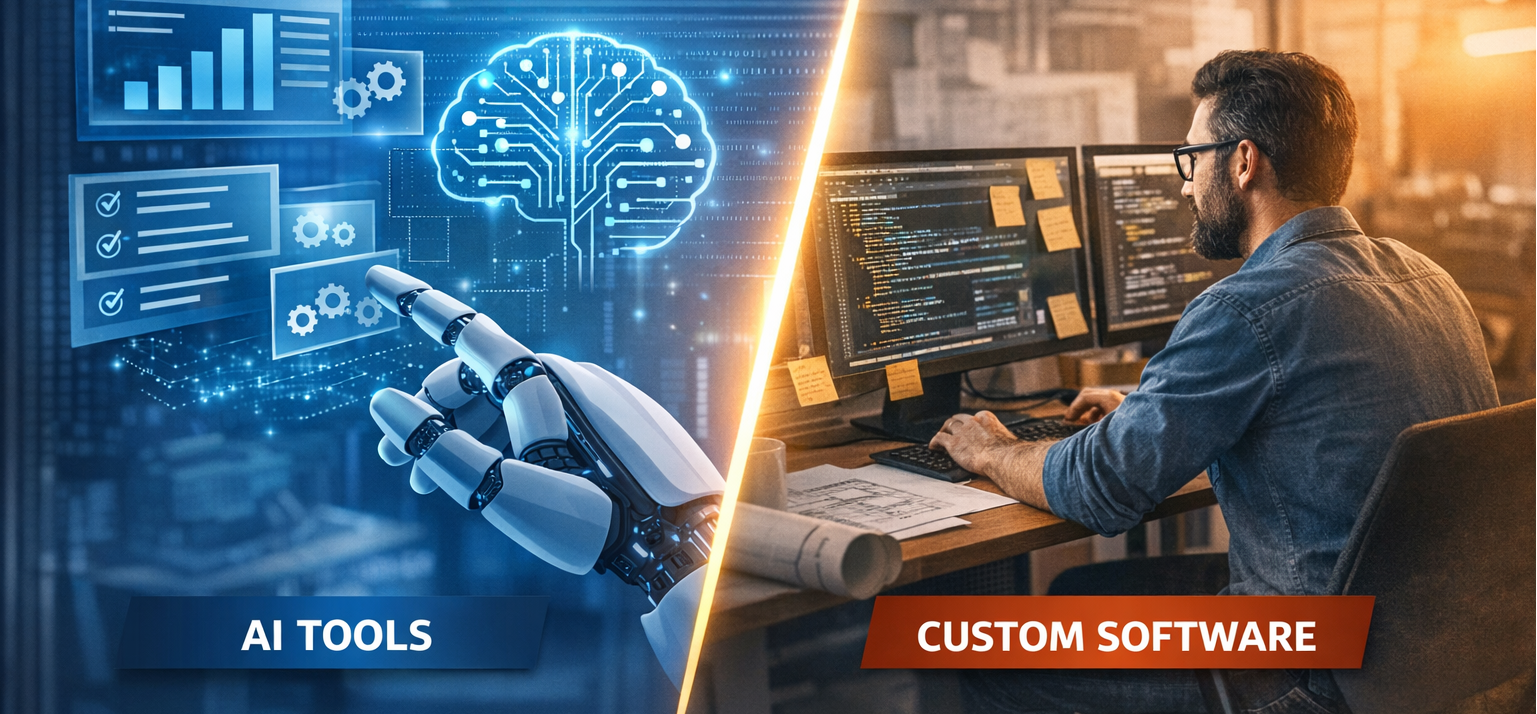
AI tools optimise for speed. Custom systems optimise for strategy. Neither is inherently better. They solve different problems.
If you need:
- A workflow tested next week
- A lightweight internal dashboard
- A temporary operational tool
AI-driven platforms are often ideal.
But if you are building:
- A mission-critical operational system
- A customer-facing platform
- A revenue-generating product
- A core workflow that defines how your business runs
Then speed alone is not the right metric.
Longevity, control, scalability, and ownership matter more.
The Ownership Factor
When you build on an AI platform or SaaS tool, you are building on rented land. That’s not necessarily bad - but it is a trade-off.
You depend on:
- Their roadmap
- Their pricing changes
- Their feature constraints
- Their uptime
- Their long-term viability
When you invest in a custom solution:
- You own the code
- You own the data structure
- You control the roadmap
- You’re not capped by arbitrary limits
- You’re not vulnerable to platform shutdowns
For businesses building foundational systems, that control can be the difference between stability and disruption.
The Architecture Dividend
There’s something we’ve observed consistently: Well-architected systems compound in value.
In the early years, the difference between a quick-build solution and a custom-engineered system may not seem dramatic.
But over time:
- New features are easier to add
- Integrations are cleaner
- Reporting becomes more powerful
- Performance remains stable
- Data remains structured and reliable
Poor architecture, on the other hand, compounds in the opposite direction:
- Workarounds multiply
- Automations become fragile
- Reporting becomes painful
- Performance slows
- Migration becomes expensive
These are not UI problems. They are foundational decisions made at the beginning.
AI Is a Tool - Not a Replacement for Judgment
We actively use AI in our own workflows.
It accelerates:
- Planning
- Prototyping
- Documentation
- Development workflows
- Testing processes
But AI is most powerful in the hands of experienced builders. It amplifies capability - it doesn’t replace architectural thinking.
The difference between an AI-generated tool and a strategically engineered system is not visible in week one. It’s visible in year five.
A Practical Approach We Recommend
The smartest strategy for many businesses today isn’t choosing one or the other. It’s sequencing them correctly.
- Use AI tools to prototype and validate.
- Refine workflows.
- Prove business value.
- Then invest in a properly architected custom solution once the model is clear.
This reduces risk. Improves clarity. Protects capital. And ensures the long-term system is built intentionally.
The Question to Ask
When considering AI-built tools versus custom development, the real question isn’t:
“How quickly can we build this?”
It’s:
“Is this tactical - or foundational?”
If it’s tactical, speed wins. If it’s foundational, architecture wins.
And architecture is where seasoned developers create long-term value.
Final Thought
AI tools are reshaping how we build software - and that’s a good thing. But sustainable systems aren’t defined by how fast they’re launched. They’re defined by how well they endure.
Some of the platforms dominating today didn’t exist five years ago. Some of the systems we’ve built for clients have been operating successfully for more than a decade. That’s not an accident. It’s the result of deliberate design decisions made long before anyone saw the interface. And in the long run, those invisible decisions matter most.