
One of the things I’ve become increasingly conscious of is the value of having our business data available in our own database.
Not just because we can report on it. Because it gives us the flexibility to continually ask new questions of our business.
We use Kanopi internally to manage our clients, projects, tickets, estimates, approvals, timesheets, scheduling and invoicing. Over time, that means we’ve built up a significant amount of structured operational data.
And recently I wanted better visibility over a few fairly simple questions:
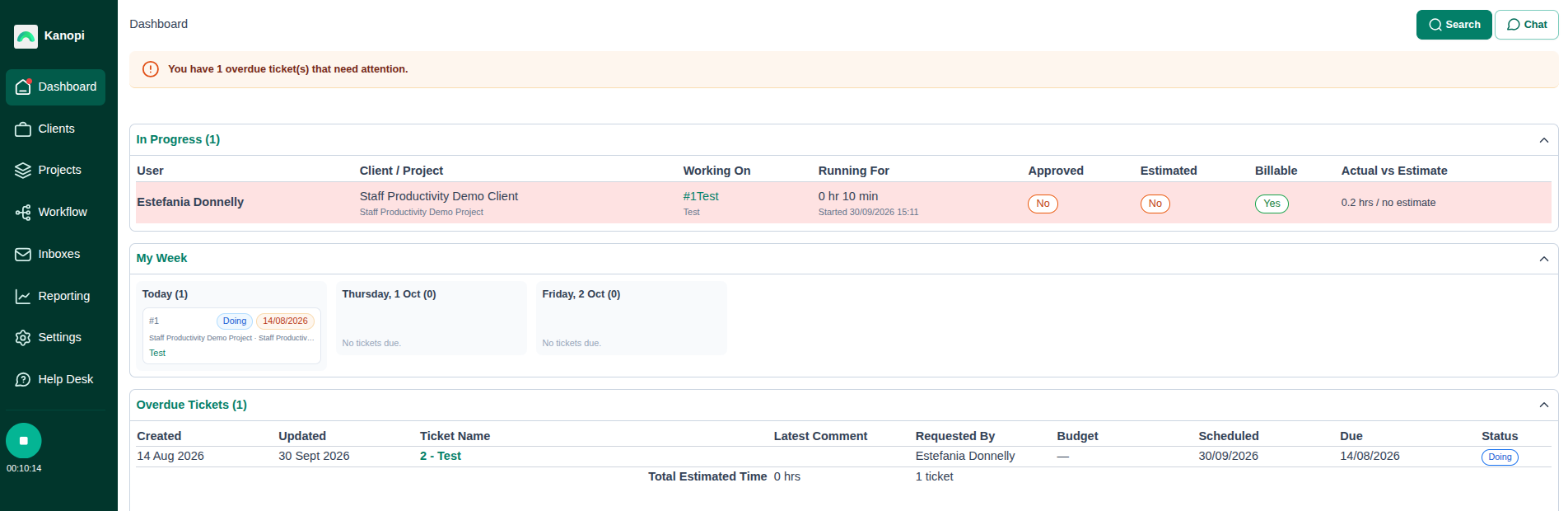
What is everyone actually working on right now?
More specifically:
- Are team members working on approved tickets?
- Has the work been estimated?
- Is the work billable?
- How does actual time compare with the estimate?
- What does each person's workload look like for the rest of the week?
- What work is overdue?
None of this required us to start collecting new data.
We already had it.
The approvals were in the system. The estimates were in the system. The tickets were there. The schedules were there. The timesheets were there.
What was missing was a way of bringing that information together so that I could see what mattered at a glance.
This is where owning your data becomes powerful
Because the data sits within a system we control, we're not restricted to the reports that somebody else decided we should have.
- We can build a new dashboard.
- We can create alerts.
- We can identify exceptions.
- We can combine information from different parts of the business.
- And increasingly, we can use AI to help us interrogate that information.
For example, instead of simply showing me a list of tickets, we can start asking questions such as:
"Show me everyone currently working on an unapproved ticket."
Or:
"Which projects have used more time than we estimated this week?"
Or:
"Which team members have overdue work and what else is scheduled for them?"
Or eventually:
"What needs my attention today?"
The underlying data hasn't changed. What has changed is our ability to use it.
AI makes good business data even more valuable
There's a lot of discussion about what businesses can do with AI.
But I think one of the most important questions comes before AI:
What data do you actually have access to?
AI is incredibly useful for interpreting, summarising and interacting with information. But it still needs information to work with. If important business information is scattered across spreadsheets, inboxes, people's heads and disconnected systems, there is only so much AI can do.
If your operational data is structured, connected and accessible, the possibilities become very different. You can start combining traditional software - rules, workflows, dashboards and reporting - with AI's ability to interpret information and answer less structured questions.
That's an incredibly powerful combination.
This is why we care about data ownership
When we build custom software for a business, we're not just trying to digitise the process that exists today. We're creating a structured record of how that business operates.
Clients. Jobs. Quotes. Tasks. Timesheets. Products. Orders. Dockets. Invoices. Payments.
Once that data exists in a structured and accessible form, you can keep finding new ways to use it. The dashboard I'm working on today wasn't necessarily something we envisaged when all of this data was originally created.
But because we have the data, we can build it.
And six months from now, I'll probably have another question that I haven't thought of yet.
That's the real flexibility. The value isn't just in the software you build today.
It's in having control of the data that lets you build what you need tomorrow.