For many trade businesses, understanding whether a job actually made money happens far too late. A quote is approved. The job starts. Staff spend time on site. Materials are ordered and used. Purchase orders are raised. Variations happen. Invoices go out. But while all of that activity is happening, one of the most important questions can be surprisingly difficult to answer:
Are we actually making money on this job?
That's a problem we've been working to solve in Trady.
Rather than building another report that looks backwards at completed jobs, we've built real-time job profitability reporting directly into the operational workflow.
The problem with reporting after the fact
Most businesses already have financial reporting. The problem is often timing.
Accounting systems are excellent at telling you what happened financially across the business. But an operations manager or project manager needs a different level of information. They need to know what's happening right now.
If a $30,000 job has already consumed too many labour hours during its first stage, knowing that three weeks after completion doesn't help much. Likewise, if material costs are running ahead of expectations, you want to identify that while there is still an opportunity to do something about it.
So we wanted Trady to bring the operational and financial sides of a job together.
Building profitability into the job itself
Every job in Trady already contains much of the information needed to understand its performance.
- We know the approved quote value.
- We know what has been invoiced.
- We know the employees working on the job and the timesheets they've submitted.
- We know the materials being used.
- We know the purchase orders being raised.
And because Trady can integrate with Xero, we can connect operational activity with the accounting workflow rather than maintaining two completely separate views of the business.
The opportunity was to bring that information together and turn it into something useful.
So that's what we've done.
A live financial picture of every job
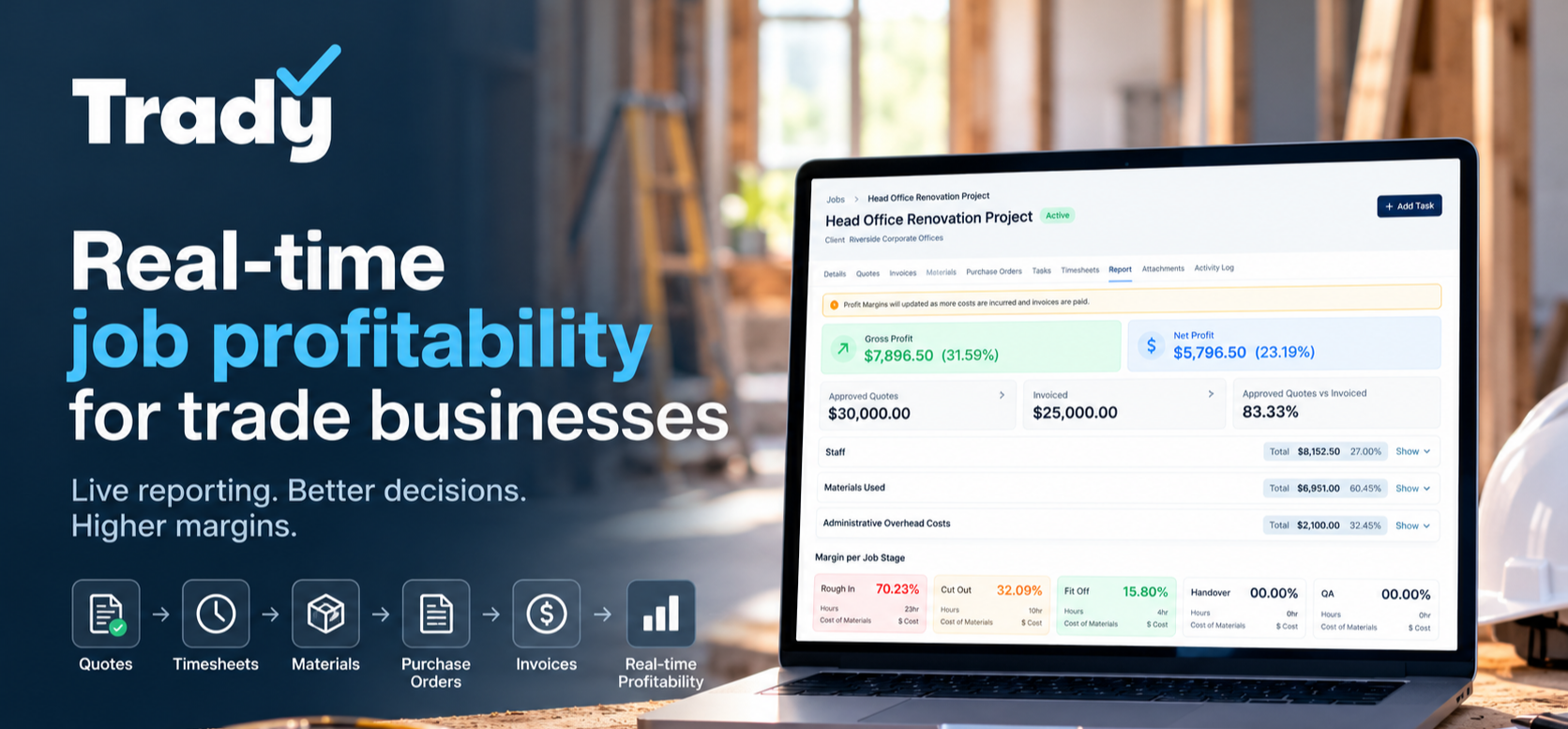
The new Job Report provides a live view of the financial position of a job.
At the top level, a manager can immediately see Gross Profit, Net Profit, Approved Quotes, Invoiced Value and the percentage of approved work that has been invoiced.
But the more interesting information sits underneath those headline numbers.
Costs are broken down into areas such as:
- staff and labour costs;
- materials used; and
- administrative or overhead costs.
Each area can then be expanded so the business can understand what's contributing to the result.
That changes the report from simply saying “your margin is 23%” to helping explain why.
Going further: profitability by job stage
For us, this was an important part of the feature. Many trade jobs aren't one piece of work. They're a series of stages.
A construction or fit-out job, for example, might move through Rough In, Cut Out, Fit Off, QA and Handover.
Looking only at the overall margin can hide what's happening inside those stages. So Trady also calculates margin per Job Stage.
A manager might see that the overall job is profitable, but Rough In has consumed significantly more labour or materials than expected. Meanwhile, Fit Off might be performing well. That's much more actionable information.
Instead of finding out that “we didn't make enough money on that job,” the business can start asking:
Which stage caused the margin problem?
Did we underestimate the labour required?
Did material costs exceed what we allowed for?
Is this happening consistently across similar jobs?
And, importantly:
Do we need to change something before the next stage starts?
From data to information
This is something we talk about regularly at Dcode.
Capturing data isn't enough. Timesheets are data. Purchase orders are data. Material usage is data. Quotes and invoices are data. The value comes from connecting that data and presenting it in a context where somebody can make a better decision.
That's what we've tried to achieve with Trady's job profitability reporting.
Rather than asking managers to export information into spreadsheets, reconcile several systems and calculate margins manually, we're using information already captured through normal business processes to continuously update the financial picture of the job.
Reporting becomes part of operations
This is also an example of where we think business software is heading.
Reporting shouldn't necessarily be a separate activity performed at the end of the month. When operational systems capture good data, reporting can become part of the workflow itself.
A timesheet is entered → labour cost changes.
Materials are allocated → material cost changes.
Work is invoiced → invoiced value changes.
The job progresses → its financial position becomes clearer.
That means management can move from reviewing what happened to seeing what's happening.
And that's a much more powerful position to be in.
Better visibility creates better decisions
The goal isn't simply to give businesses more dashboards. It's to surface information at the point where someone can actually use it.
If a job is performing well, great.
If a stage is starting to consume too many hours, the business can investigate.
If materials are eating into margin, they can understand why.
If approved work hasn't been invoiced, it becomes visible.
And over time, completed jobs provide better information for estimating and quoting future work.
That's the real opportunity.
Better operational data → better visibility → better decisions → better margins.
And instead of waiting until the job is over to find out whether it was profitable, Trady can help businesses understand the answer while there's still time to do something about it.